If you have been using Claude, ChatGPT, or any other AI tool recently, you may have come across the term MCP. It sounds technical. It is not — not really. This guide explains what it means in plain language, why it is suddenly everywhere in 2026, and what it can actually do for you if you run a Shopify store.
The problem: AI is smart but stuck
Claude can write, reason, summarise, plan, and answer almost anything. But out of the box, it cannot do things in the real world. It cannot check your orders, update your store, send an email on your behalf, or look up a record in your database. It can only talk.
The reason is simple: there is no connection. Claude lives inside its own window. Your Shopify store, your CRM, your email platform — they all have APIs (doors that let software talk to them), but Claude has no key for any of those doors.
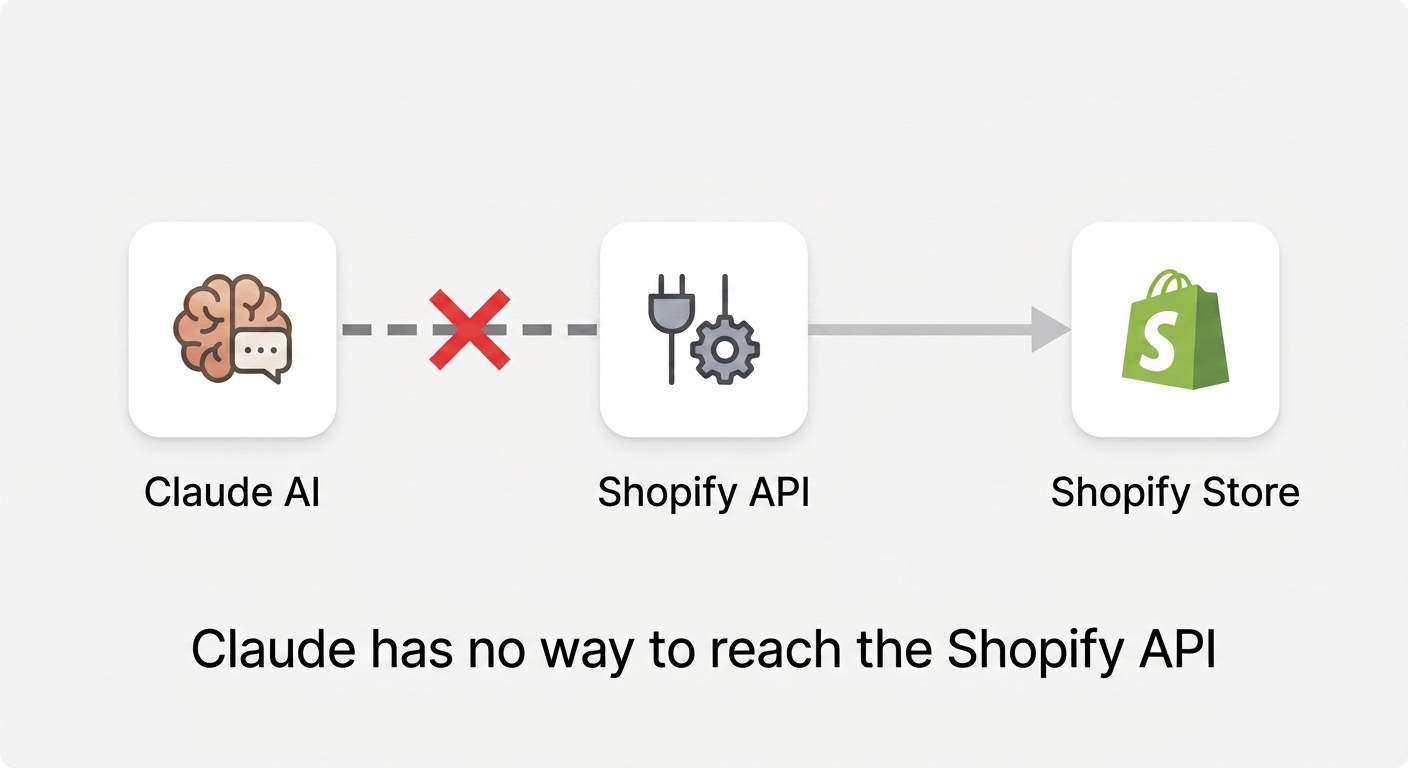 Without MCP — Claude and outside services like Shopify cannot communicate.
This is the problem MCP solves.
What MCP actually is
MCP stands for Model Context Protocol. It is an open standard — basically a shared set of rules — that defines how an AI tool like Claude can connect to an outside service and use it.
Think of it like a universal plug socket. Before MCP, every AI integration was its own bespoke wiring job. With MCP, any service that builds an MCP server instantly becomes available to any AI client that supports the standard — Claude, ChatGPT, Gemini, and others.
MCP was introduced by Anthropic (the company behind Claude) in late 2024. OpenAI (ChatGPT) and Google (Gemini) both adopted it in 2025. It is still new, but it is already the default way to connect AI to the real world.
In practical terms: an MCP server is a small piece of software that sits between an AI and a service. When Claude wants to do something — check an order, update a product, fetch a web page — it sends a request to the MCP server. The server translates that into an API call, gets the result, and passes it back to Claude. From your side, you just type and things happen.
Who supports MCP in 2026
MCP is not a niche experiment. Every major AI has adopted it:
- Claude (Anthropic) — full MCP support in claude.ai and Claude Desktop
- ChatGPT (OpenAI) — MCP support added in early 2025
- Gemini (Google) — MCP support confirmed 2025
- Claude Code, Cursor, Windsurf — all support MCP natively
This matters because it means an MCP server you build once works across all of them. One integration — every AI client.
What you can connect with MCP
MCP is not specific to Shopify. It works for almost anything that has an API. Here are some real examples of MCP servers that already exist:
Shopify
Manage your store — edit themes, update products, create pages, handle orders.
Email
Write and send campaigns, manage subscriber lists, check open rates.
Database
Create tables, run queries, insert and read data — in plain language.
Web browsing
Fetch any page as clean text for research, monitoring, or summarising.
CRM
Look up contacts, log calls, update deal stages — all through conversation.
Internal tools
Connect Claude to your own APIs, databases, or back-office systems.
If a service has an API, it can have an MCP server. That is the point — MCP turns any API into something an AI can use conversationally.
ShopMCP — a real example for Shopify
To make this concrete, here is how MCP works in practice using ShopMCP — the MCP server we built for Shopify stores.
Without ShopMCP, Claude has no way to reach your store. Your store has a Shopify API, but Claude cannot access it. There is simply no connection.
ShopMCP sits in the middle. It connects Claude to your Shopify API and exposes 34 tools — things Claude can now do in your store: read theme files, edit them, create pages, update products, manage navigation, write blog posts, and publish everything directly. No developer needed.
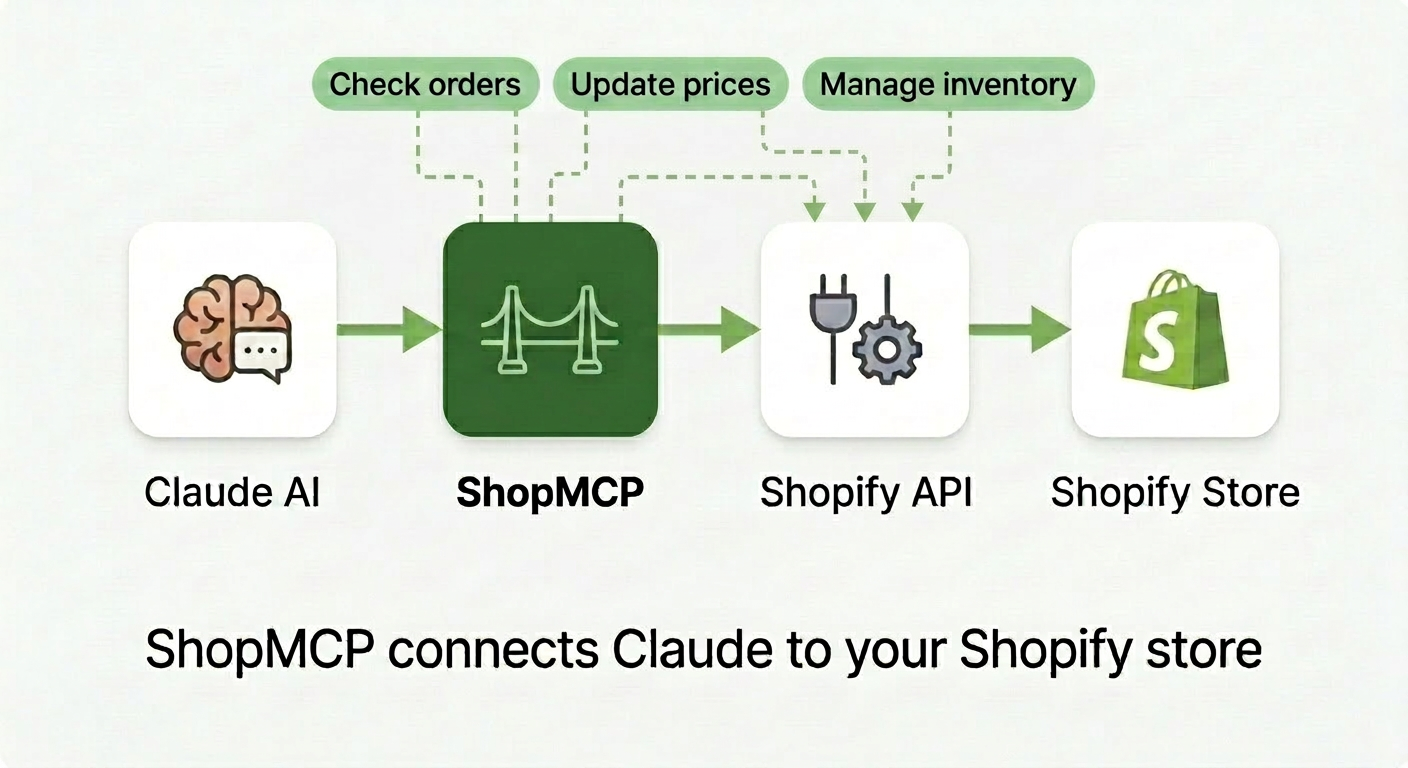 With ShopMCP — Claude sends requests through the MCP server to your Shopify store and gets results back.
Here is what you can actually type to Claude once ShopMCP is connected:
"Show me all unfulfilled orders from today"
Claude pulls your open orders — no digging through the admin.
"Add a free shipping banner to the header"
Claude edits your theme and publishes it live in seconds.
"Rewrite the description for my winter jacket"
Claude rewrites it and pushes it to the product page directly.
"Create a Summer Sale landing page"
Claude builds the page and publishes it to your store. Done.
"Which products have less than 5 in stock?"
A clear list without exporting anything or opening a spreadsheet.
"Write and publish a blog post about summer care tips"
Claude writes it and publishes it straight to your Shopify blog.
This is what MCP looks like in practice — not a chatbot answering questions about your store, but an AI actually making changes in it, on your behalf, in plain language.
How to try it yourself
If you run a Shopify store, you can try ShopMCP free for 30 days. Setup takes under 5 minutes — install the app, copy one URL into Claude, and you are ready.
If you are curious about MCP more broadly — for your own service, your internal tools, or a SaaS product — we build custom MCP servers at Anderseen. One quote, fixed price, senior engineers only.
Try ShopMCP free on your store
30-day free trial. No credit card required. Connect Claude to your Shopify store in under 5 minutes.
Install Free on Shopify
30-day free trial · From $4.90/mo · Cancel any time